
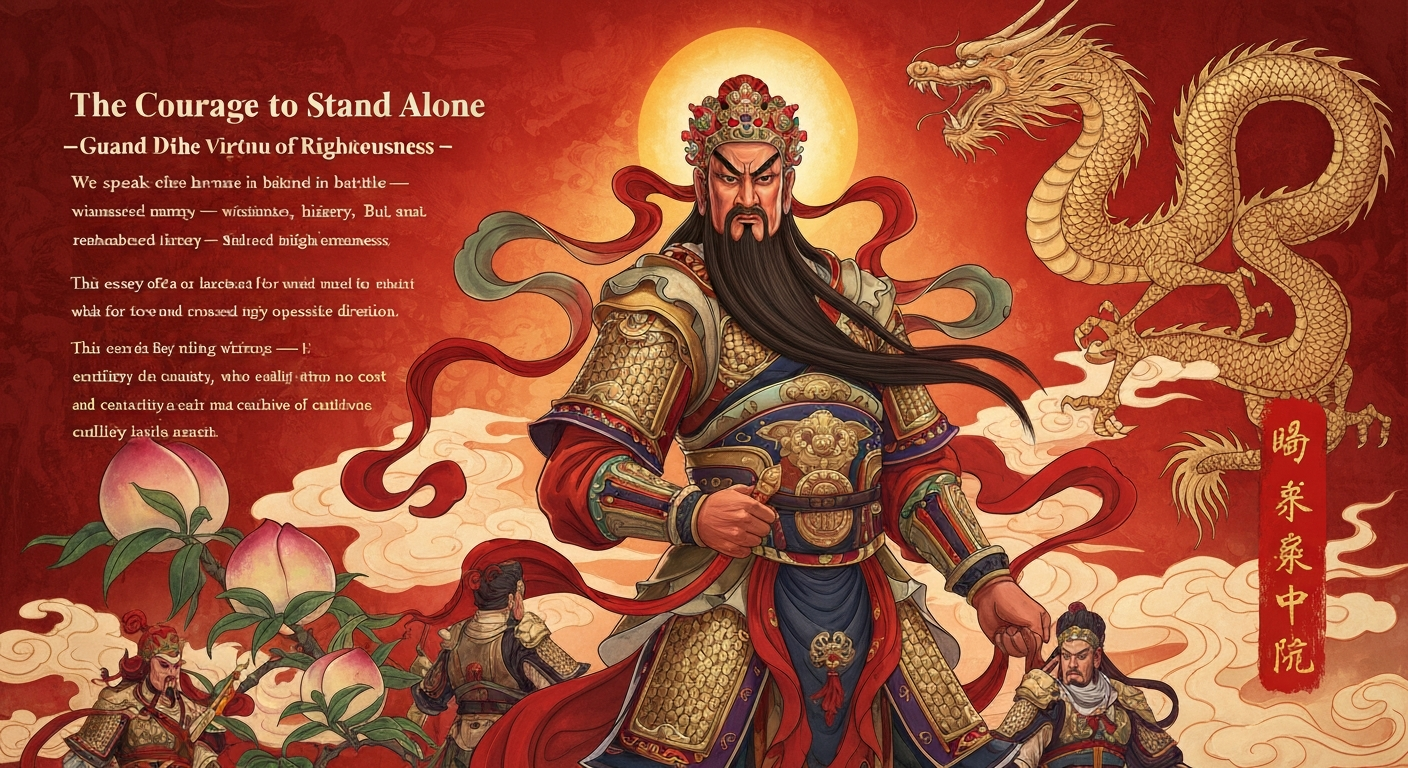
"It is not the sword that makes a hero. It is the willingness to stand where others will not."
Introduction
We speak often of bravery in battle — the visible kind, witnessed by many, remembered in history. But 关帝圣君 — Guan Di, the Sacred Emperor of Righteousness — embodies a harder and quieter form of courage: the courage to stand for what is right when the crowd moves in the opposite direction, when no one is watching, when the cost falls entirely upon the self.
This essay explores righteous courage as a living virtue — not something confined to generals and warriors, but a quality each of us must cultivate in our daily lives.
The Courage That Costs Something
It is easy to agree when everyone agrees. It is easy to stay silent when silence protects us. The moral courage that Guan Di represents is not this comfortable courage. It is the courage that steps forward precisely when stepping forward is difficult.
In classical Chinese virtue, 义 — righteousness — is not simply doing what is correct in the abstract. It is the willingness to bear the weight of a right action even when that action is costly. Guan Di's life is a testament to this: he chose loyalty over self-interest, honour over convenience, and the bond of brotherhood over the easier path of neutrality.
This kind of courage asks something real of us. It may mean speaking truthfully when a pleasant lie would preserve the peace. It may mean refusing to participate in something we know is wrong, even when our refusal creates friction. It may mean standing by a friend whose position has become unpopular, or challenging a decision that benefits us personally but harms others.
The Inner Battlefield
Guan Di is a warrior, but his greatest battles were interior. The question he faced — what kind of man will I be? — is the same question every person faces in the small moments that no poet will record and no temple will commemorate.
The inner battlefield is where courage is truly decided. Before we can act rightly outwardly, we must first overcome the temptations inwardly: the voice that says it is not your problem, the fear of being ostracised, the desire to be liked, the rationalisation that a small compromise is harmless.
Guan Di's example is not that he never faced these temptations. It is that he identified what he valued most deeply — brotherhood, loyalty, righteousness — and returned to that centre each time the temptation arose.
Reflection / Lesson
True courage is not the absence of fear. It is the decision that something matters more than the fear. Guan Di knew fear. He knew what it meant to lose — companions, territory, advantage. And still, he chose the right thing.
We will all face moments — perhaps not grand or dramatic — where we must decide whether our values are something we merely admire, or something we actually live. In those moments, we can invoke the spirit of Guan Di: not to summon supernatural strength, but to remember that integrity is its own armour, and that a life lived honestly needs no defence.
Closing Prayer / Dedication
May the spirit of Guan Di strengthen all who face a moment of righteous decision today. May we find the courage to stand where it is difficult to stand, to speak when it costs something to speak, and to be the kind of person who, at the end of the day, can look clearly at the altar and say: I kept my word.
伏惟关帝圣君,英雄气概,忠义长存。🙏
独立之勇——关帝圣君与正义坚守的德行
"使人成为英雄的,不是刀剑,而是在旁人退却之处,依然愿意站立的那份勇气。"
引言
我们常常谈论战场上的英勇——那种众目睽睽之下的勇气,被历史铭记的勇气。然而关帝圣君所体现的,是一种更难、也更沉默的勇气:在众人背道而驰之际,在无人注视之时,在代价全由自身承担之刻,依然站在正义一边的那种勇气。
这篇文章探讨正义之勇作为一种活生生的德行——它并非将军与武士的专属,而是每个人在日常生活中都必须修炼的品质。
需要付出代价的勇气
当众人皆同意,附和很容易。当沉默能保护自己,缄默很容易。关帝所象征的道德勇气,并非这种舒适的勇气。它是在挺身而出最为困难之时,依然迈步向前的勇气。
在中国传统道德观中,"义"并不仅仅是抽象意义上的"做正确的事"。它是即便代价沉重,也愿意承担正义行动之重量的意志。关帝的一生便是明证:他选择忠诚而非私利,选择荣誉而非便利,选择义结金兰的情谊而非明哲保身的中立。
这种勇气要求我们真实地付出。它或许意味着在一个善意的谎言能维护和平时,选择说出真相;或许意味着拒绝参与我们明知有悖道义的事,即便这种拒绝制造了摩擦;或许意味着在一位朋友的立场变得不受欢迎时,依然站在他身旁;或许意味着挑战一个让我们受益、却伤害他人的决定。
内在的战场
关帝是武将,但他最伟大的战役发生在内心。他面临的那个问题——"我要成为怎样的人?"——正是每个人在那些不会被诗人记录、不会被庙宇纪念的细小时刻中所面对的问题。
内在的战场,才是勇气真正被决定的地方。在我们能外在地行正之前,必须先战胜内在的诱惑:那个说"这与你无关"的声音,被孤立的恐惧,渴望被人喜爱的心理,以及"小小妥协无伤大雅"的自我开脱。
关帝的榜样,不在于他从未面对这些诱惑,而在于他认清了自己最深处珍视什么——义气、忠诚、正义——并在诱惑涌来时,一次次回归那个中心。
感悟与启示
真正的勇气不是没有恐惧,而是决定有某件事比恐惧更重要。关帝也曾感到恐惧。他知道失去意味着什么——失去同伴,失去疆土,失去优势。即便如此,他仍选择了正义。
我们都会面临那些时刻——或许并不宏大、并不戏剧——在那一刻,我们必须决定:我们的价值观,究竟是我们所仰慕的,还是我们真正活出的。在那样的时刻,我们可以召唤关帝的精神:不是祈求超自然的力量,而是记住——正直本身就是铠甲,诚实度过的一生无需任何辩护。
结语与回向
愿关帝圣君的浩然之气,在今日面临正义抉择的人心中注入力量。愿我们找到勇气,在难以站立之处站立,在开口代价高昂之时开口,成为那种在一天终了时,能坦然望向神位说一声"我信守了誓言"的人。
伏惟关帝圣君,英雄气概,忠义长存。🙏
Explore Other Deities · 了解其他神明
To know more about other deities and decipher their oracle lots, visit: