
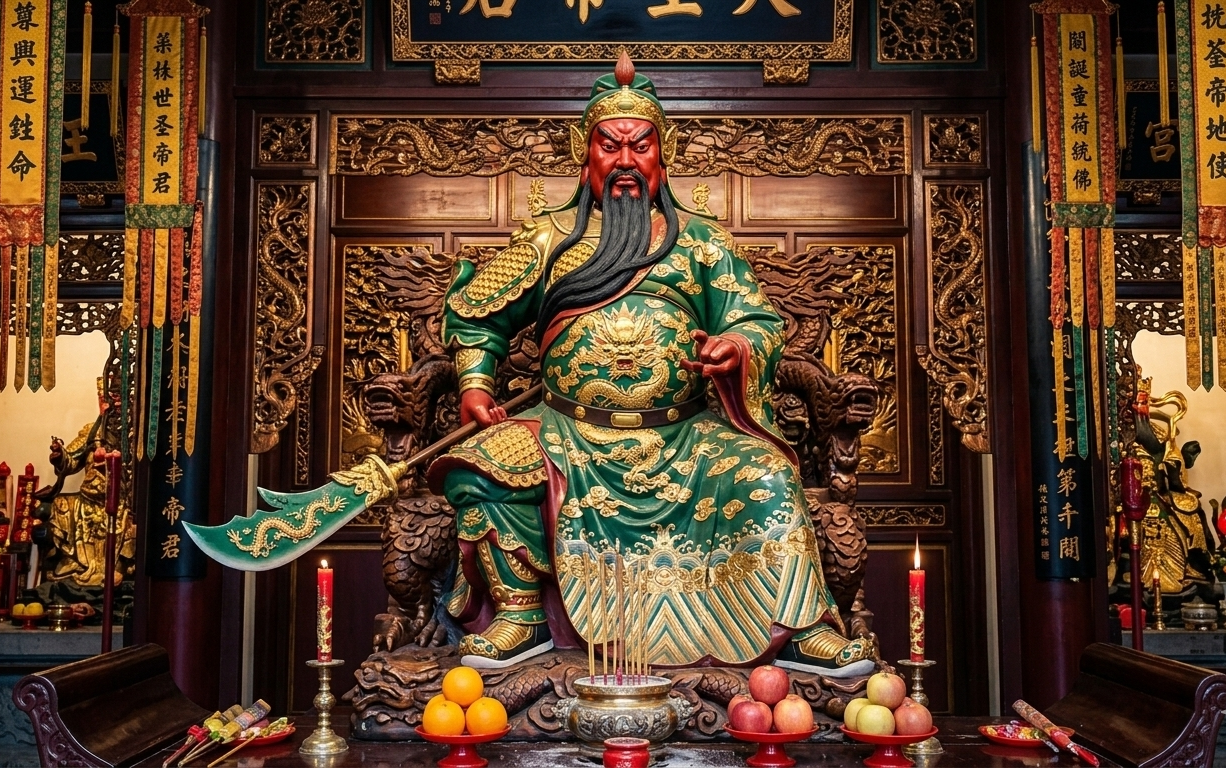
Guan Di (關帝), also known as Guan Yu (關羽), Guan Gong (關公), and Lord Guan, is one of the most revered deities in Chinese religion and culture. He began his journey as a mortal man — a warrior of unmatched loyalty, valor, and righteousness — and through his deeds in life and the devotion of countless generations, was elevated to the status of a god worshipped across temples, homes, and businesses throughout the Chinese world.
Born in the Eastern Han dynasty (around 160 CE) in Xie County, Hedong (present-day Shanxi Province), Guan Yu was described as a man of imposing stature, with a red face, long beard, and eyes like the phoenix. In his youth, he killed a local bully to defend the weak, then fled his hometown and became an itinerant warrior who sought righteousness over profit.
The defining moment of his life came when he met Liu Bei and Zhang Fei and swore the famous Oath of the Peach Garden (桃園結義). This oath — to serve the people, to never betray one another, to be born in different years but die on the same day — became the foundational moral narrative of Chinese brotherhood. Guan Yu pledged absolute loyalty to Liu Bei's cause, and every chapter of his life honoured that pledge.
The most celebrated story of his integrity came when he was captured by Cao Cao, the rival warlord. Cao Cao treated him with extraordinary generosity — offering wealth, titles, a magnificent horse, and beautiful women. Guan Yu accepted his host's kindness graciously, but made clear he would return to Liu Bei the moment he knew where his sworn brother was. When news came, he returned all the gifts, killed Cao Cao's generals who tried to stop him, and passed through five passes, fighting six generals, until he was reunited with Liu Bei. His loyalty was absolute, his integrity unbroken.
Guan Yu met his end in 219 CE, captured by the forces of Eastern Wu during a military campaign and executed alongside his son. But death only amplified his legend. Stories of his spirit appearing in dreams, protecting soldiers in battle, and judging the deeds of the living circulated across China. By the Tang dynasty he was worshipped in temples; by the Song dynasty he had received imperial titles; by the Qing dynasty he held the extraordinary title: “Holy Emperor Guan, God of War, Subduer of Demons, Protector of the Nation, Patron of Commerce”.
Today, Guan Di temples are found across China, Taiwan, Hong Kong, Macau, and Chinese communities worldwide. He is worshipped by soldiers and police officers who seek his protection, by businesspeople who invoke his integrity as the foundation for honest dealings, by martial artists who revere his skill, and by ordinary families who seek his guidance in righteous living.
The oracle lots of Guan Di have a long history in Chinese temples. Devotees bring sincere questions — about ventures, relationships, conflicts, or major decisions — and through the lot-drawing ritual, receive a poem that reflects Guan Di's wisdom as a judge of human affairs: fair, perceptive, and deeply attuned to questions of righteousness and honor.
In a world where loyalty is rare and integrity is costly, Guan Di stands as a testament that such virtue is not only possible, but worthy of the highest honour. His life was not without defeat or sorrow — but he never abandoned his principles. This is why he inspires: not because he was invincible, but because he chose righteousness in the face of every temptation.
关帝:忠义千秋,神威赫赫
关帝(关公、关羽),是中国历史上最著名的武将之一,亦是深受华人世界崇拜的神明。他生于东汉末年(约公元160年),河东解县(今山西省)人,相传面如重枣、髯长二尺、凤眼蚕眉,气度非凡。年轻时,关羽因为打抱不平,杀死一名仗势欺人的地方豪强,被迫离乡流亡,辗转各地。
后在涿郡与刘备、张飞相遇,三人义气相投,在桃园结义,誓言「不求同年同月同日生,但求同年同月同日死」,共谋匡扶汉室之大业。这一誓言,成为中华文化中义气、忠诚最深刻的象征。
关羽最为人称道的,是「过五关斩六将」的故事:曹操以厚礼款待关羽,赠以赤兔马、金帛无数,封以官爵。然而关羽明确表示,效忠之心属于刘备,一旦得知刘备下落,必当归去。当消息传来,他归还所有馈赠,挂印封金,突破重围,义无反顾地回到刘备身边。
公元219年,关羽在荆州兵败,被东吴军队捉获,与子关平一同被杀。然而,他的死不是终结,而是神话的开始。历朝历代对他不断加封,至清代,他的封号已长达数十字,集战神、财神、护国神于一身,庙宇遍及中华大地乃至海外华人社区。
关帝庙遍布全球。军人与警察向他祈求平安与庇护,商人向他祈求诚信兴业,武术家向他致敬,普通百姓则向他寻求公正的裁决与精神上的庇护。
在关帝庙中,求签是传统的信仰仪式。信众带着真诚的疑问——关于商务合作、家庭纷争、重大抉择——虔心摇签,依签诗领受关帝的指引。这不仅是一种占卜,更是在关帝的正义面前,对自身行为与动机的审视。
关帝的精神内核,是一个「义」字:忠义于兄弟,仁义于百姓,道义于天地。他提醒世人,真正的力量不在于征服,而在于坚守正道,哪怕付出生命。因此,他被世人铭记,被神明接纳,千年不衰。
Explore Other Deities · 了解其他神明
To know more about other deities and decipher their oracle lots, visit: